
Six types of insurance most people have never heard of— and why one of them might be exactly what you've been missing.
Most people know about health insurance, life insurance, and car insurance. But beyond those household names, there's a whole category of coverage that rarely gets talked about. And for many people, that gap is costing them when the harder days of life really hit.
Whether you're dealing with a gap in coverage, worried about a family health history, self-employed without a safety net, or simply looking for smarter ways to protect your finances, there are supplemental insurance options most people don't know exist. And here's the part that surprises almost everyone: most of them don't require a qualifying life event. You can enroll at any time of year.
Here is a plain-language guide to six types of coverage I work with every day at Shipley Benefits. I cover what each one does, who it's built for, and why it might be worth a conversation. Read through to know your options, give me a call if you’d like more information on any of them, and then save this guide for later if circumstances change!
1. Short Term Medical Insurance
Best for: Coverage gaps, affordability, transitions
Short Term Medical Insurance is often the first alternative people should explore when traditional health coverage isn't accessible or affordable. It's real medical coverage — covering doctor visits, urgent care, emergency room visits, and hospitalizations — at a significantly lower monthly premium than most Marketplace plans.
Who should consider it?
You're between jobs and COBRA quotes are out of reach
You're waiting for open enrollment to begin
You've aged off a parent's plan and need a bridge
Marketplace premiums simply don't fit your budget right now
There are a few important things to understand before enrolling. Short Term Medical plans are medically underwritten, which means pre-existing conditions are typically not covered. These plans also don't meet ACA requirements, so they're not a qualifying plan under the Affordable Care Act.
That said, for someone who is generally healthy and needs real coverage during a temporary gap, Short Term Medical can be one of the smartest financial decisions you make. I always walk through the specifics with each client to make sure it's a genuine fit for their specific needs.
2. Accident Insurance
Best for: Active families, sports, outdoor lifestyles
I'll be transparent here: my family has an Accident Insurance policy, and we have used it more times than I'd like to admit! Between sports injuries and general household chaos, it has paid for itself many times over.
Accident Insurance pays cash benefits directly to you— not to your doctor or hospital— when you experience a covered injury. You decide where the money goes: the ER copay, the physical therapy bills, the groceries while you're recovering. No restrictions.
Covered benefits typically include:
Emergency room visits, ambulance, and X-rays
Fractures, dislocations, and lacerations
Physical therapy and follow-up care
A Sports Package that increases benefits by 25% for organized sports injuries
This plan is particularly valuable for families with kids in sports, adults who ride motorcycles or ATVs, people who love outdoor recreation, or anyone who tends to be—as I call it—accident-prone. It supplements your existing health insurance, and you can enroll without a qualifying event.
3. Hospital Indemnity Insurance
Best for: High-deductible health plan holders
Even with good health insurance, a hospital stay can create significant financial strain. The average annual health insurance deductible for single coverage is $1,735— and that's before coinsurance applies.
Hospital Indemnity Insurance addresses this directly. It pays a cash benefit when you're admitted to the hospital, with additional daily benefits for each day you're confined. Like Accident Insurance, the money is paid directly to you.
Key benefits typically include:
Hospital admission benefit ($500 to $1,500 depending on plan)
Daily confinement benefit for each day of your stay
ICU confinement benefit
Observation room and ER coverage
Waiver of premium while you're hospitalized
Hospital Indemnity doesn't replace your health insurance— it stacks on top of it. Think of it as a financial buffer between you and your deductible when an unexpected hospitalization occurs.
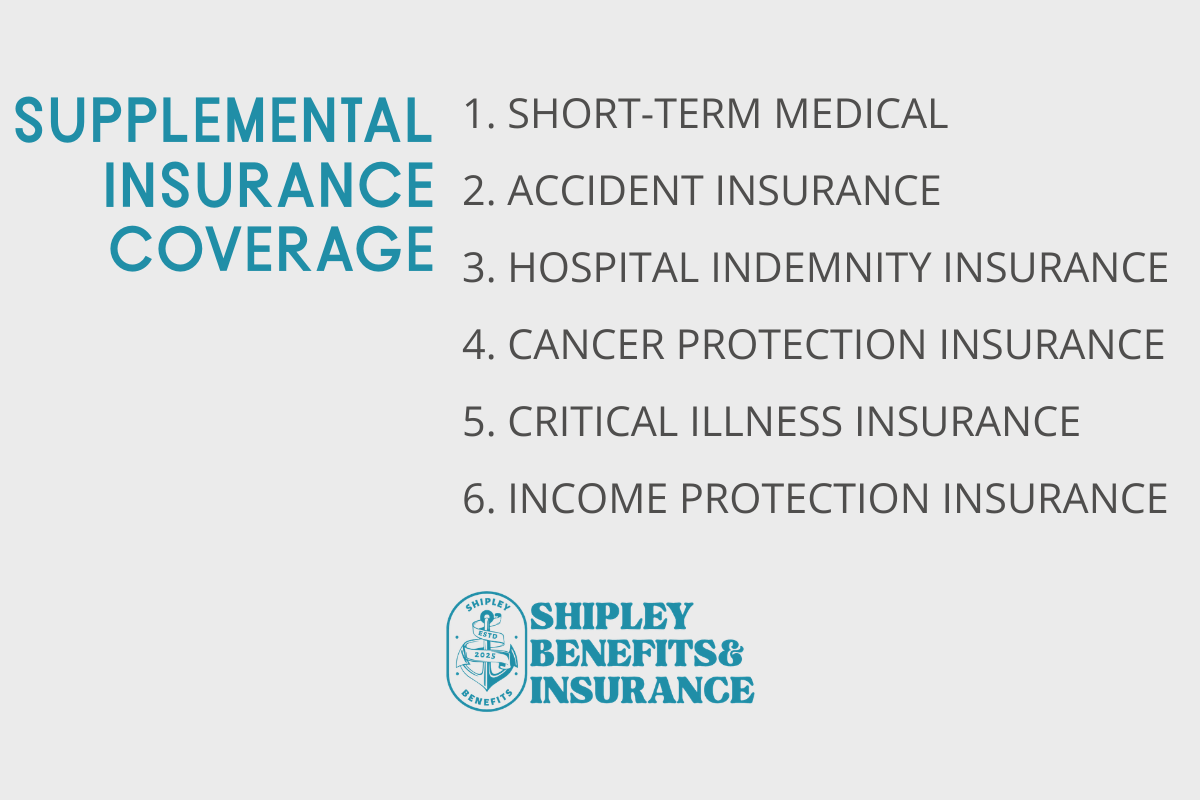
4. Cancer Protection Insurance
Best for: Those with a family history of cancer
Nearly 40% of Americans will be diagnosed with cancer at some point in their lifetime. It's a statistic that affects most of us in one way or another, whether personally or through someone we love.
A Cancer Protection plan provides cash benefits throughout the treatment journey, not just at diagnosis. Benefits are paid directly to you and can be used for anything: medical bills, travel to treatment centers, household expenses, or time off work for a caregiver.
Covered benefits typically include:
Hospital stays during inpatient cancer treatment (daily benefit)
Radiation and chemotherapy (up to $3,000 lifetime)
Surgery and anesthesia (up to $2,000 for surgery)
A first occurrence benefit of $5,000 cash upon initial covered diagnosis
Ground ambulance and transportation for treatment travel
This is a supplement to your health insurance, not a replacement. Pre-existing conditions are covered after 24 months, and the policy is guaranteed renewable for your lifetime. For anyone with a family history of cancer, this coverage is worth a serious look.
5. Critical Illness Insurance
Best for: Those with a family history of chronic conditions
As we all get older, we begin to make peace with our own genetic risks for heart disease, stroke, paralysis, and other serious health issues. While we can't change our genetics, we can prepare for them financially.
Critical Illness Insurance pays a lump-sum cash benefit upon diagnosis of a covered serious condition. Unlike ongoing supplemental plans, this is a one-time payment you receive and can deploy however your situation requires — out-of-pocket medical costs, household bills during recovery, travel to specialized care, or simply the peace of mind of having cash on hand.
Like all the plans covered in this guide, Critical Illness insurance can be purchased on an individual basis, any time of year, without a qualifying event.
72% of Americans say they would struggle to meet their financial obligations if their paycheck were delayed by just one week.
6. Income Protection Insurance
Best for: Self-employed, hourly workers, new parents, anyone without paid leave
I call this one "insurance for your paycheck," because that's exactly what it is.
Consider this: 72% of Americans say they would struggle to meet their financial obligations if their paycheck were delayed by just one week. One week. Now think about what a six-week recovery from surgery, childbirth, or a serious injury could mean for your finances.
Income Protection Insurance pays monthly cash benefits when a disability prevents you from working. You choose the benefit amount, the benefit period (six months, one year, or two years), and an elimination period (or the number of days you must be disabled before benefits begin).
Scenarios where this coverage matters most:
Recovery from surgery or a serious accident
Extended maternity recovery, especially after a C-section
A health crisis that sidelines you from your job for months
Self-employment with no employer-provided disability safety net
This plan is available to individuals with no employer required. It's one of the most overlooked yet most impactful policies I discuss with clients, particularly those who are self-employed or work in fields without paid sick leave.
The Common Thread
Every plan described in this guide shares three important characteristics:
No qualifying event required, meaning you can enroll any time of year.
Cash benefits paid directly to you, so you have no restrictions on how you use them.
Portable coverage means your plan stays with you even if you change jobs.
None of these supplemental insurance plans are a substitute for comprehensive health insurance. But for some, these options changes the way they think about their financial protection and what's actually available to them.
If any of these resonated with you, I'd welcome a conversation. At Shipley Benefits, every client gets personalized, one-on-one attention. There's never any pressure, just honest guidance about what actually makes sense for your life.
