
Lost Job-Based Coverage? Let’s talk Health Insurance Options
Losing job-based health insurance is one of those life moments that can feel immediately overwhelming. You're already dealing with a transition— whether that's a layoff, a resignation, a contract ending, or a business closing— and now you've got a clock ticking on your health coverage.
Here's what I want you to know first: you have options. Real ones. And you don't have to figure this out alone by sitting on hold with an insurance company for an hour. Let’s walk through what's actually available to you.
How Much Time Do You Have?
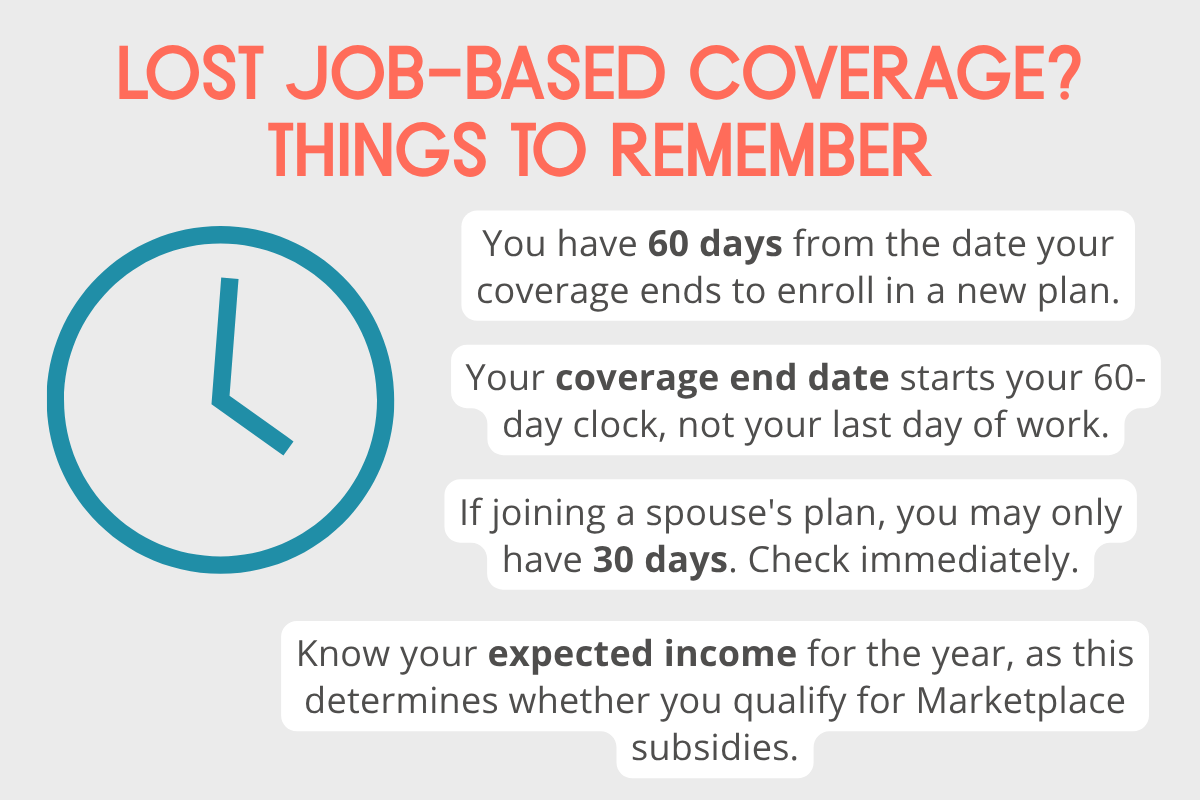
When you leave a job and lose group health insurance, you typically have a 60-day special enrollment period to find new coverage. That window starts on the date your coverage ends— not the date your job ends, which can sometimes be a few weeks later.
This matters because 60 days sounds like a lot of time, but it tends to creep up on you. I've talked to so many people who thought they had more runway than they did. Mark the date your coverage ends, set a reminder, and treat this as a real deadline.
Option 1: COBRA
COBRA allows you to keep your exact same employer-sponsored health plan by paying the full premium yourself— including the portion your employer was previously covering on your behalf.
For a lot of people, that number is a genuine shock. The average employer covers well over half of an employee's monthly premium. When you lose that contribution, you might go from paying $150 a month to receiving a COBRA quote for $600, $700, or more.
That said, COBRA isn't always the wrong choice. If you have ongoing medical care, prescriptions, or providers you really can't afford to switch, staying on your existing plan for a period of time can be worth the cost. COBRA coverage can last up to 18 months, and in some circumstances, up to 36 months.
My honest take: COBRA makes the most sense when you have a specific, near-term reason to need continuity on your exact plan. For everyone else, there are usually more affordable paths worth exploring.
Option 2: The ACA Marketplace
Losing job-based coverage is a qualifying life event, which means you can enroll in an ACA Marketplace plan outside of the standard open enrollment window. Your 60-day special enrollment period applies here.
Marketplace plans are comprehensive. This means they cover preventive care, prescriptions, mental health services, and hospital care, and they cannot deny you coverage based on a pre-existing condition. Depending on your projected income for the year, you may also qualify for premium tax credits that significantly reduce your monthly cost.
This is often the first thing I walk people through, because the subsidy piece surprises a lot of people. If you've left a salaried position and your income will be lower this year, you might be eligible for meaningful financial assistance that makes Marketplace coverage much more affordable.
One important note for 2026: the enhanced subsidies that made Marketplace plans even more affordable over the past few years expired at the end of 2025. Premiums are higher this year than they were in 2024 or 2025. That doesn't mean the Marketplace is off the table, just that it's more important than ever to actually run the numbers with someone who really understands the numbers, rather than guessing based on last year's experience.
Option 3: A Spouse or Domestic Partner's Plan
If your spouse or domestic partner has employer-sponsored health insurance, losing your own coverage is typically a qualifying event that allows you to join their plan outside of their open enrollment period. This is worth checking immediately, because for many people it's the most straightforward and cost-effective option available.
The one thing to watch for: you usually have 30 days from the date you lose your coverage to request to be added, not 60. Check the specific rules of your partner's plan as soon as possible.
Option 4: Medicaid
If your income has dropped significantly— whether because of a job loss, a transition to self-employment, or another change— you might qualify for Medicaid, which is free or very low-cost coverage administered at the state level.
Unlike Marketplace plans, Medicaid doesn't have an enrollment window. You can apply at any time of year if you meet the income requirements. Eligibility varies by state, but if your income is below a certain threshold (generally around 138% of the federal poverty level in states that expanded Medicaid), it's worth checking.
Option 5: Short-Term Medical Insurance
If the Marketplace premiums are out of reach and you don't qualify for Medicaid, Short-Term Medical Insurance is worth understanding. These plans provide real medical coverage— doctor visits, urgent care, emergency care, hospitalizations— at a significantly lower premium than most ACA plans.
The trade-offs are important to know upfront. Short-term plans are medically underwritten, so pre-existing conditions are generally not covered. They also don't meet ACA requirements. That means they're not a substitute for comprehensive health insurance, but for a healthy person navigating a temporary gap, they can be a smart bridge.
This is one of those options that's genuinely helpful for the right person and genuinely not right for others. I always walk through the specifics with each client before recommending it.
What Should You Actually Do First?
First, find out the exact date your coverage ends. Not your last day of work, your last day of coverage. Then note your 60-day special enrollment window from that date.
Second, gather a rough sense of your expected income for the rest of the year. This affects your subsidy eligibility on the Marketplace, which affects your actual costs.
Third, talk to someone who can look at your specific situation— your income, your health needs, your state, your budget— and explain your actual options. Not a call center. Not an algorithm. A real person.
That's exactly what I do at Shipley Benefits. Whether you're between jobs, newly self-employed, leaving a corporate career to start something of your own, or in any other in-between moment. I've helped people in all of those situations find coverage that actually works for their life.
You don't have to figure this out alone, and you don't have to settle for whatever quote pops up first online.
Shipley Benefits & Insurance works with individuals and small businesses nationwide to make benefits simple, understandable, and actually helpful. If you're navigating a coverage gap or a life transition, let's talk.
