
If your group health renewal came in higher than you hoped, you are not alone. More small business owners are looking beyond the traditional group plan, and two options keep coming up in our conversations: level-funded health plans and ICHRAs.
Both can be a great fit for the right business, yet both are still unfamiliar to many small business owners. Level-funded plans have become common among small employers, with nearly 4 in 10 covered workers at small firms now enrolled in one, according to KFF's 2026 Employer Health Benefits Survey. ICHRAs are newer, but more than 20,000 businesses now offer an ICHRA or a similar reimbursement arrangement, according to the HRA Council.
Here is a plain-language look at how each one works, who it may suit, and what to weigh before you decide.
What is a level-funded health plan?
A level-funded plan is a self-funded health plan with built-in protection, packaged to feel a lot like traditional coverage. You pay one predictable amount each month, and that payment covers three things: a fund set aside to pay your employees' claims, the cost to administer the plan, and stop-loss insurance.
The stop-loss piece is what makes this workable for a small business. If claims run unusually high, either for one person or for the group as a whole, stop-loss insurance covers the costs above a set limit, so one serious illness doesn't put your business at risk.
Here is the part many owners like: if claims come in lower than expected, some plans return a portion of the unused funds. The details vary by carrier, and some require you to renew to receive that surplus, so it is worth asking before you sign.
Is a level-funded plan For You?
Level-funded plans often work best for groups that are generally healthy. Unlike traditional small group plans, they can take your employees' health history into account when setting the price. For a healthy group, that can mean a lower monthly cost than a fully insured plan. For a group with higher expected claims, the savings may not show up.
A few things to understand before you choose a level-funded plan:
Renewal is not guaranteed the way it is with a traditional plan, and your pricing can change based on your group's claims.
Level-funded plans are not fully insured, so they may not include every state-required benefit and follow different rules than traditional small group plans.
You will have more reporting and administrative responsibilities than with a fully insured plan.
Money back at the end of the year is possible, but it is never guaranteed. It depends on your claims and how your plan is designed.
None of this means level-funded is the wrong choice. It means it is worth reviewing with someone who can walk you through the fine print.
What is an ICHRA?
An ICHRA, short for Individual Coverage Health Reimbursement Arrangement, lets you give employees a set monthly allowance to buy their own health insurance. Instead of choosing one group plan for everyone, you decide how much you want to contribute, and each employee picks an individual plan that fits their needs, on the Marketplace or off it.
The employee buys the plan and shows proof of coverage, and you reimburse them tax-free, up to the allowance you set. There are no minimum or maximum contribution limits, and you can set allowances by employee class (such as full-time and part-time) as long as the same terms apply within each class.
ICHRAs have been available since 2020 and are open to employers of any size.
Who an ICHRA may fit
An ICHRA can be a strong fit when a traditional group plan feels out of reach. Maybe the cost is too high, or your team can't meet a carrier's participation requirements, which can call for a high share of eligible employees to enroll. An ICHRA does not come with that requirement.
It is also a way to offer health benefits for the first time. According to the HRA Council, more than two-thirds of the small businesses offering an ICHRA in 2026 had no health benefits before.
Here is what to keep in mind:
Your employees do the shopping, so they might want some guidance choosing a plan. That is where Shipley Benefits comes in!
Individual coverage has its own enrollment windows, so timing matters if you want coverage to start January 1.
Your cost is a budget you control, but plan choices, networks, and pricing vary by employee and location.
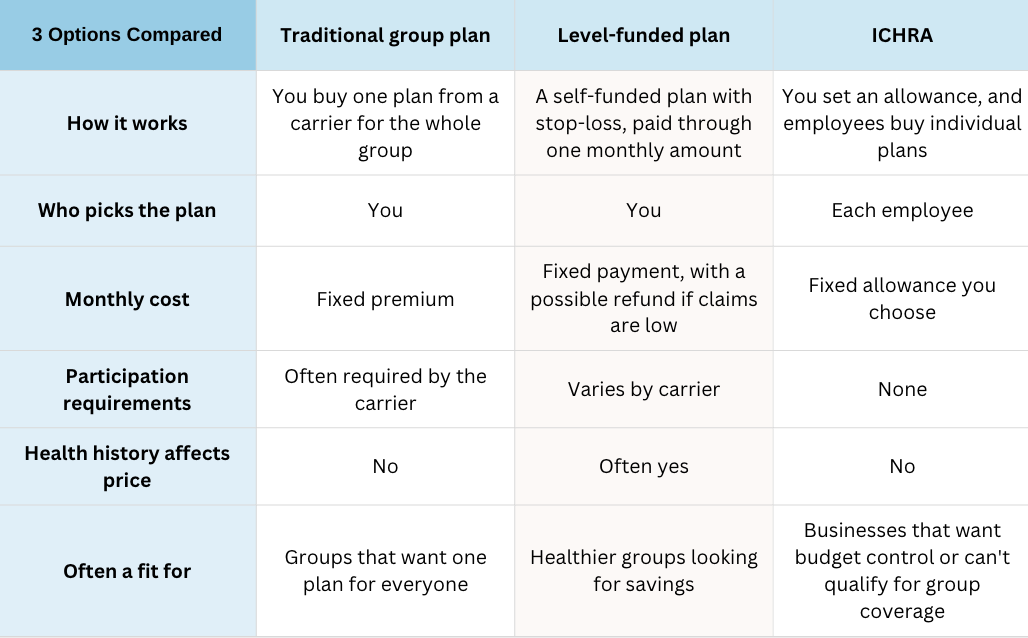
Side by side
Here is how the three approaches compare at a glance.
How to decide, and why timing matters
The right option depends on your team, your budget, and how much risk and administration you are comfortable with. A few questions can help you get started:
Is your group generally healthy?
Do you want one plan for everyone, or more choice for your employees?
Have you had trouble meeting a carrier's participation requirements?
How involved do you want to be in managing the plan?
Timing matters too. Many employer plans renew on January 1, and Marketplace enrollment for 2027 coverage runs from November 1 to December 15 for coverage that begins January 1 (with January 15 being the hard end of Marketplace open enrollment). If you are thinking about a change for the new year, the next few weeks are the time to start the conversation.
At Shipley Benefits, we help small businesses compare all of their options, including traditional group plans, level-funded plans, and ICHRAs, so you can choose with confidence and without the jargon. If you'd like to talk through what makes sense for your team, book a free 30-minute benefits consult. We'd love to help.
